
Group learning in the early years refers to structured and unstructured activities where young children learn alongside their peers, developing skills through shared experiences, collaboration and social interaction. It encompasses everything from circle time and small group games to paired problem solving, outdoor exploration and creative projects.
Rather than relying solely on adult-led instruction, group learning encourages children to observe, communicate, negotiate and build knowledge together, laying foundations that support later academic and social success.

Why Is Group Learning Important In Early Years?
Group learning is important in early years because it strengthens children’s social, emotional and cognitive skills simultaneously. Research indicates that around 70% of learning in early childhood is influenced by social interaction, highlighting just how central peer experiences are to young children’s development.
When children engage in shared tasks, they naturally practise turn-taking, listening and empathy. They learn that others may have different perspectives and that cooperation often leads to a more enjoyable and successful outcome. These early lessons help children develop emotional regulation and confidence.
In addition, group learning environments offer rich language opportunities. Young children are exposed to new vocabulary, sentence structures and storytelling patterns by listening and speaking with peers.
They pick up social language cues, learn how to initiate conversations and become more confident expressing their thoughts. This naturally boosts communication skills, which play a crucial role in later literacy development.
How Does Group Learning Support Cognitive Development?
Group activities help children solve problems and think logically because they observe how others approach the same challenge. When a child sees a peer stacking blocks differently or notices another child using a creative method to sort objects by colour or shape, they are inspired to test new ideas. This shared thinking strengthens reasoning and early mathematical awareness.
Group learning also deepens children’s understanding by encouraging discussion. For example, when children are exploring the life cycle of a butterfly, one child may recall seeing one at home, while another may connect the activity to a story they know.
These exchanges mean that children build knowledge by linking their own ideas with those of others. This collaborative process helps children move from simple recognition to more complex understanding.
What Skills Do Children Develop Through Group Learning?
Group learning nurtures a wide range of essential life skills. Socially, children learn cooperation, negotiation and conflict resolution. They practise fairness and patience as they wait their turn, share materials and work towards group goals. Emotionally, they gain confidence when their contributions are valued by peers and adults alike.
Cognitively, children develop early problem-solving skills by tackling challenges together. They learn how to make predictions, test ideas and evaluate outcomes. Creativity also flourishes in group settings, as children are exposed to multiple imaginative perspectives. Whether designing a den outdoors or creating a group mural, children benefit from blending their ideas with those of others.
Physically, group learning can support fine and gross motor development during different activities or music and movement sessions. The varied nature of group tasks ensures children develop holistically rather than in isolation.
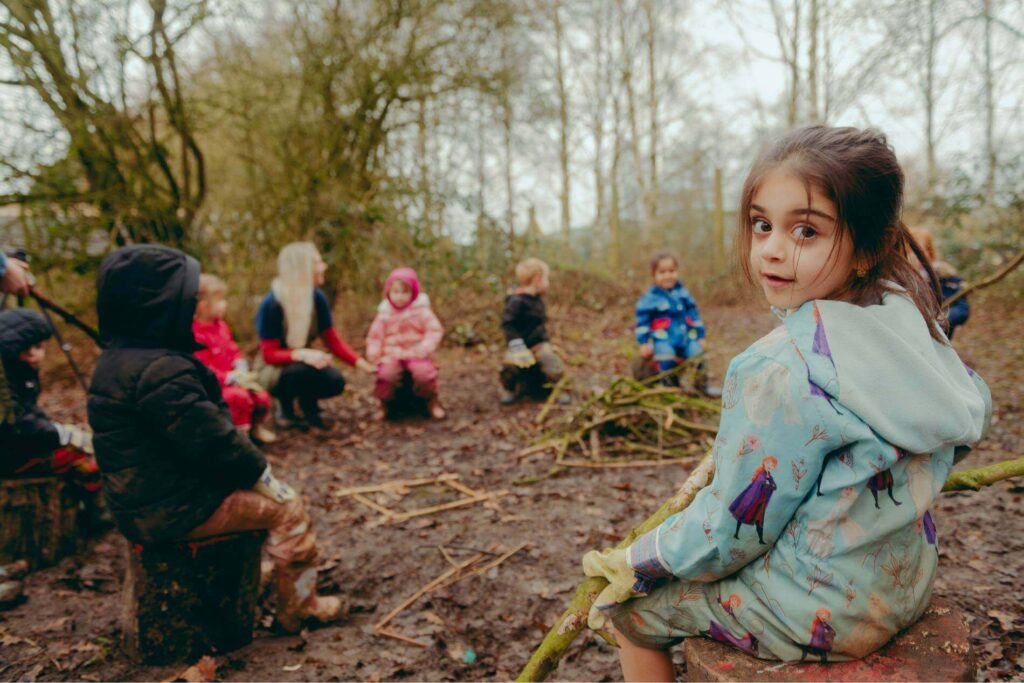
Outdoor play is another powerful setting for group learning. Nature offers endless opportunities for children to work collaboratively, whether they are building shelters or creating imaginative role-play scenarios.
Concluding Thoughts
Group learning in the early years is a vital part of childhood development, offering children opportunities to gain social confidence, build friendships, practise problem solving and explore the world with curiosity. Through shared experiences, children develop essential skills that prepare them for school and life beyond.
At Jack and Jills Day Nursery, we pride ourselves in offering rich group learning opportunities that helps every child to thrive, grow and discover their unique potential.